Knock Fever
- 4.6
- Rating
- 500.00K
- Installs
- Free
- Price

 Analysis by App-foxy
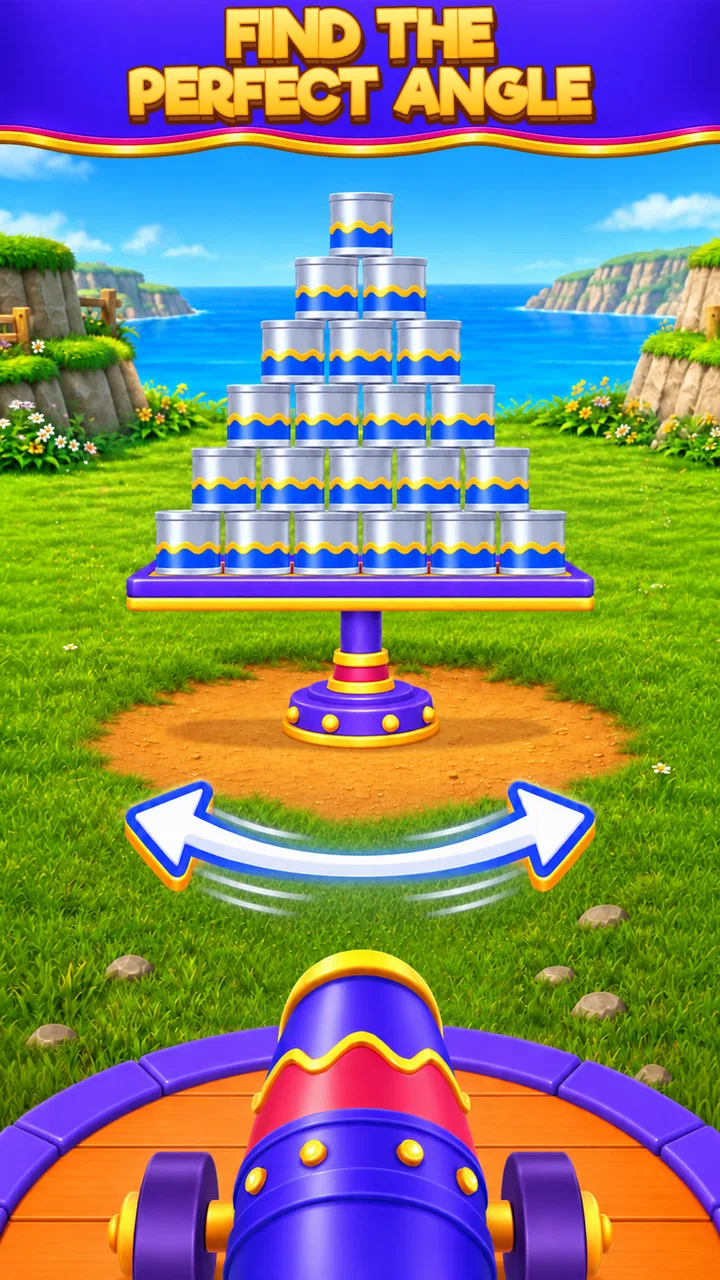
Knock Fever is a free puzzle game from Kite Games AS built around a simple idea: aim powerful cannon shots at towers and clear each level. I found the appeal easy to understand within a few rounds. It gives me a direct objective, quick feedback, and the kind of short challenge that fits naturally into a spare moment rather than demanding a long uninterrupted session.
That simplicity is both its strongest quality and the main question a potential player should consider. This is not presented as a sprawling strategy game or a story-driven adventure. It is a focused blast-and-clear experience, designed for people who enjoy working out how to bring down structures efficiently. If that sounds satisfying, the free entry point makes it easy to test. If you need deep progression, extensive variety, or a more demanding puzzle format, the experience may feel narrower than the category’s richer alternatives.
How the cannon puzzles feel in everyday play
My first impression is that Knock Fever works best when I treat each level as a small problem rather than a reflex challenge. The tower is the immediate target, but the satisfying part comes from deciding where a shot will do the most useful work. A direct hit is not always the most interesting choice; the shape of the structure encourages me to look for a point that can start a larger collapse.
You May Also Like

 Blood Strike: 2.5 Anniversary
Blood Strike’s Loadouts Turn Every Drop Into a Tactical Gamble
A close look at Blood Strike’s custom loadouts: how fast access to signature weapons reshapes its battle royale rhythm, rewards preparation, and narrows the gap between fights.

 Pandora - Music & Podcasts
Pandora’s Music Is Easy to Start, but Harder to Recover
Pandora’s strength is its low-effort path from a seed to a station. Its weak spot is how much confidence it asks you to place in connection, setup, and quiet recovery.

 8 Ball Pool
 Is Built on Rivalries, Rematches, and Routine
A close look at the rivalries, rematches, shared routines, and unanswered safety questions that turn a quick pool match into a persistent mobile community.

 Samsung Music
’s Quiet Strength Is Playing What You Already Own
Its reach comes less from spectacle than from dependable access to a personal library. That simplicity is both the app’s strongest retention engine and its ceiling.

 AccuWeather: Weather Radar
AccuWeather Review: A Quick, Clear Forecast for Everyday Decisions
For everyday plans, the best forecast is the one you can understand quickly. AccuWeather makes rain timing, radar, and local conditions easy to act on, with a few trade-offs.

 Hill Climb Racing
Why Hill Climb Racing Still Turns Crashes Into One More Run
A tiny car, a bumpy hill and one more upgrade: Hill Climb Racing keeps resurfacing because its simple chaos makes every near-miss feel personal.
More From Our News Desk
View All News


That makes the game a good fit for short sessions. I can open it while waiting for an appointment, play a few stages during a commute, or use it as a quick mental reset between tasks. The premise is clear enough that I do not need to remember a complicated plot or rebuild a large strategy after putting the phone down. I simply return to the next tower and focus on the shot in front of me.
The puzzle category matters here. Although the cannon gives the game an energetic surface, the useful skill is observation. I am weighing the visible structure, predicting how force might travel through it, and trying to avoid wasting an opportunity. That balance keeps the action from becoming only a sequence of taps. The best moments come when a carefully chosen strike does more than the obvious shot.
I would not describe it as a traditional logic puzzle with long written clues or abstract grids. Its questions are physical and visual: where should I aim, what section looks vulnerable, and how can I turn one impact into a cleaner result? Players who enjoy spatial reasoning may appreciate that immediate style, while people looking for word puzzles, number puzzles, or elaborate deduction systems should know that this is a different kind of mental workout.
A practical way to approach each level
My most useful habit is to pause before firing instead of treating the first visible target as the correct one. I look at the tower as a connected arrangement and search for a supporting area that appears more important than its size suggests. This small delay changes the feel of the game: I am no longer simply reacting to what is on screen, but making a deliberate attempt to solve the layout.
I also find it helpful to separate a good shot from a merely successful one. Clearing a level is the immediate goal, but an efficient solution usually feels more rewarding because it suggests that I understood the structure rather than relying on repeated attempts. That distinction gives the game some replay value for players who like improving their decisions, even when the basic objective remains straightforward.
Another useful approach is to avoid rushing after an imperfect opening. A shot that does not produce the result I expected can still reveal how the tower responds. Instead of immediately repeating the same action, I reassess the remaining shape and adjust the next angle. This is a small but meaningful trade-off: patience can make the game feel thoughtful, while hurried retries can turn it into trial and error.
These observations are not complicated hidden systems; they are ways of getting more from the central mechanic. The store summary tells me that the game is about blasting towers with cannon shots, but the practical enjoyment comes from learning to read each arrangement. That is where the puzzle identity becomes clearer than the action wording alone suggests.
What the free entry point really means
Knock Fever is free to download and play, which removes the biggest barrier for someone who is curious about the concept. I can try the core experience without committing to an upfront purchase. That is especially useful for a compact puzzle game because the right question is personal: do the cannon-and-tower interactions stay enjoyable after the novelty of the first few rounds?
There are in-app purchases ranging from $0.99 to $199.99 per item. I would therefore approach the game with a clear spending limit, particularly if I am handing the phone to a child or using a payment method shared with family members. The Everyone age rating makes it broadly approachable, but an age rating does not replace sensible purchase controls. The free download is real value for testing the game; it should not automatically be treated as unlimited value without considering optional spending.
The purchase range also changes how I judge the game. I do not need to buy anything to decide whether the basic puzzle loop works for me, so I would play first and spend later only if the experience has earned that decision. For this kind of title, paying can make sense for a player who already enjoys the levels and wants to support continued play, but it makes less sense as an impulse response to a single frustrating stage.
Because the game is free, it competes less with paid puzzle games on initial cost and more on how well it uses my attention. A paid alternative may offer a more controlled, uninterrupted experience, while Knock Fever offers a low-risk trial with optional purchases. Neither approach is automatically better. The choice depends on whether I value immediate access or prefer paying once for a clearly defined package.
Where the experience delivers value
The strongest value is convenience. Knock Fever gives me a visually direct task that I can understand quickly, and its cannon mechanic gives every level a clear point of focus. I do not need a long explanation before I can make a meaningful decision. That makes it suitable for casual players who want something more engaging than passive scrolling but less demanding than a large strategy game.
It also offers value through repeatable decision-making. Even when the objective is familiar, the satisfaction can come from finding a cleaner way through a tower. Players who enjoy optimizing their own approach may continue after simply reaching the end of a stage, because the challenge is not only whether the structure falls but whether the solution feels controlled.
For me, the game is most useful as a short attention exercise. I can play a few levels when I want a break that still asks me to notice patterns and make choices. It is not a substitute for a deep brain-training program, and I would not use it for that purpose. Its value is lighter and more immediate: a compact puzzle loop with a physical payoff.
The current version is 2.4.0, and the game supports devices running Android 7.1 or later. That makes the compatibility requirement relatively approachable for people using older supported Android hardware. Still, I would check the device’s available storage, performance, and screen responsiveness before judging the game on a particular phone, since cannon aiming and visual feedback are more comfortable when controls respond cleanly.
The game has reached over 500 thousand installs, with an average rating of 4.6 from around 16 thousand ratings. Those figures suggest that the central idea has found a substantial audience, but they do not tell me whether every player will enjoy the same pace or level of variety. I see them as a reason to investigate rather than a guarantee. The best test remains a personal one: install it, try the free experience, and decide whether the tower puzzles hold my attention.
Trade-offs that affect long-term enjoyment
The main limitation is the narrowness of the core loop. Cannon, tower, shot, result: that clarity is attractive at first, but players who need frequent changes in genre or structure may eventually want more. Someone seeking a puzzle game with a story, character development, elaborate rules, or several distinct modes should look elsewhere. Knock Fever’s identity depends on doing one thing clearly rather than trying to cover every kind of puzzle.
There is also a difference between casual satisfaction and serious challenge. The game can be pleasant when I want a low-pressure activity, but a player who expects the complexity of a demanding physics sandbox or a carefully layered logic campaign may find the decisions too immediate. The cannon gives the game energy, yet the experience remains accessible enough for an Everyone audience. That accessibility is a benefit for newcomers and a possible drawback for experts looking for severe difficulty.
Optional purchases are another point to weigh. The free starting point is friendly, but the presence of items priced as high as $199.99 means I would not browse the purchase screen casually. I prefer to establish whether the game is worth my time before considering any payment. If I want a completely purchase-free environment, a one-time paid puzzle game may be a better match, even if its upfront cost is less flexible.
Short-session design can become a weakness for people who want a substantial evening game. I enjoy being able to dip in and out, but that same structure may leave a player wanting more context or a stronger sense of progression. This is not a flaw in every situation; it is a mismatch for a particular type of player. Knock Fever is easier to recommend as a quick puzzle habit than as the only game on a device.
I would also avoid judging it solely by the excitement of the cannon theme. The important question is whether I enjoy examining towers and refining shots. If I mainly want explosive visual action with little thought, a conventional arcade game may provide a better fit. If I want pure logic with no physical destruction, a classic grid or word puzzle will probably be more satisfying. Knock Fever sits between those expectations, using action presentation to deliver a visual puzzle.
Who is most likely to get their money’s worth
Casual puzzle players are the clearest audience. If I like games that explain themselves quickly, reward a moment of planning, and work well in short sessions, this is an easy one to try. The free price makes experimentation sensible, while the Everyone rating broadens its appeal to households looking for an approachable game rather than an intense competitive experience.
It can also suit players who enjoy improving a solution after the basic objective is complete. Instead of stopping at “the tower fell,” I can ask whether I used the best target, whether I reacted too quickly, and whether a more efficient shot would feel better. That self-imposed layer is important because it adds depth without requiring the game to become complicated.
Families should consider it as a simple shared game, with one practical condition: adults should manage purchase settings before letting younger players explore freely. The age rating supports broad accessibility, but the available in-app purchase range makes supervision worthwhile. A child who enjoys the cannon premise may focus on the immediate fun and not understand the financial meaning of an item purchase.
People who should skip it are those who dislike repetition in a central mechanic. If the idea of repeatedly aiming at towers sounds tiring rather than satisfying, the free download will not change that reaction. I would also steer away from it if I wanted a long narrative, multiplayer competition, or a puzzle system built around words and numbers. A different game can be better even when Knock Fever is well made for its own purpose.
My buy-or-skip verdict
I recommend trying Knock Fever because the free entry point makes the decision low risk. Its best quality is the clean relationship between observation and action: I study a tower, choose a cannon shot, and see the consequence immediately. That makes it a practical companion for short breaks and a pleasant option for players who enjoy visual problem-solving without a heavy ruleset.
I would not recommend buying in-app items immediately. I would first play enough to learn whether the central loop remains enjoyable beyond the first impression, then decide whether any purchase has genuine personal value. The range from $0.99 to $199.99 per item is broad enough that careful spending matters. Free access is the strongest value proposition here; paid value depends entirely on how much I continue to enjoy the specific puzzle cycle.
My final view is positive but targeted. Knock Fever is worth trying for anyone who wants a free, accessible tower-blasting puzzle with quick visual decisions. It is less convincing as a choice for players demanding deep systems, a large variety of puzzle types, or a fully defined one-time purchase. Kite Games AS has built the game around an immediately understandable idea, and that focus works when I want a short, satisfying challenge rather than a complete gaming world.
In practical terms, I would install it for a spare-minute routine, play without spending first, and pay only after the game has proved that its cannon puzzles deserve a regular place on my phone. That approach matches what it does best: offer an easy start, a clear goal, and enough room for careful players to find satisfaction in making each shot count.
FAQs for Knock Fever
01What is Knock Fever and how does the game work?
Knock Fever is a casual action game built around quick matches, timing, and strategic attacks. Players generally control a character or team, face opponents in short rounds, and try to knock them out or complete the objective before the match ends. The gameplay is easy to understand, but winning consistently requires learning movement, attack timing, defensive actions, and the strengths of each available character or ability.
02Is Knock Fever free to download and play?
Knock Fever can typically be downloaded without an upfront purchase, allowing users to try the main gameplay at no initial cost. However, the game may include optional in-app purchases for cosmetic items, upgrades, extra content, or other conveniences. Availability of specific purchases can vary by platform and region. Check the store listing and payment settings before downloading, especially if children use the device.
03Does Knock Fever require an internet connection?
An internet connection may be necessary for features such as online matches, account synchronization, advertisements, leaderboards, events, and updates. Some parts of the game may work offline, but the available functionality can be limited when mobile data or Wi-Fi is disabled. For the smoothest experience, use a stable connection during competitive play, since interruptions could cause delays, disconnections, or lost match progress.
04Is Knock Fever suitable for children and beginners?
Knock Fever is generally approachable for beginners because its controls and basic objectives can be learned quickly through the opening stages or tutorial. Nevertheless, the level of suitability depends on the game’s current content, advertising, chat features, and purchase options. Parents should review the age rating, supervise online interactions, and enable device-level purchase restrictions if younger players will be using the app.
05What should I check before installing Knock Fever on my phone?
Before installing Knock Fever, check that your Android or iOS device meets the minimum operating-system requirements and has enough free storage for the download and future updates. It is also worth reviewing battery usage, permissions, privacy details, and the developer’s latest update notes. If you plan to play online, confirm that your connection is reliable and that the game is officially available in your region.
Pros
- Fast-paced matches are easy to start and finish in short sessions.
- Simple controls make the game accessible to new players.
- Unlockable content gives you reasons to keep playing.
- Bright visuals and punchy effects make hits feel satisfying.
- Works well as a casual game for quick breaks.
Cons
- Progress can feel repetitive after playing several matches.
- Some upgrades or rewards may require considerable grinding.
- Frequent action can make the screen feel visually hectic.
- Limited strategic depth may disappoint experienced players.
- Performance and battery use may vary on older devices.

Knock Fever
Gallery